
By: Vincent Maraviglia ‘28 – Published in Fall 2024 Issue 2
Welcome to the Movie Minute! My name is Vincent, and I will be your go-to guy for anything involving film! The time has come for ghosts, ghouls, and frights. With the spooky season upon us, it’s only fitting to review a film that will surely send a shiver down anyone’s spine. Well, for children, that is. Today, I will be reviewing Coraline.
Coraline was originally a novella written by Neil Gaiman in 2002 and follows a young Coraline Jones as she and her family move to an old Victorian House in Oregon. While there, Coraline discovers the entrance to another world where her “Other Parents” are waiting for her. Coraline enjoys the Other World more than the real one but soon realizes that all may not be as it seems. Coraline’s Other Mother desires to sew buttons into Coraline’s eyes in order to keep her there forever and captures Coraline’s real parents in order to do so. Coraline must outwit the Other Mother in order to rescue her parents and release the souls of the children that the Other Mother has killed.
Shortly before the release of the novella, Gaiman wanted to create a film adaptation and approached Henry Selick, a stop-motion animator whose previous films include “The Nightmare Before Christmas” and “James and the Giant Peach.” The film would finish production and release in 2009, to massive success.
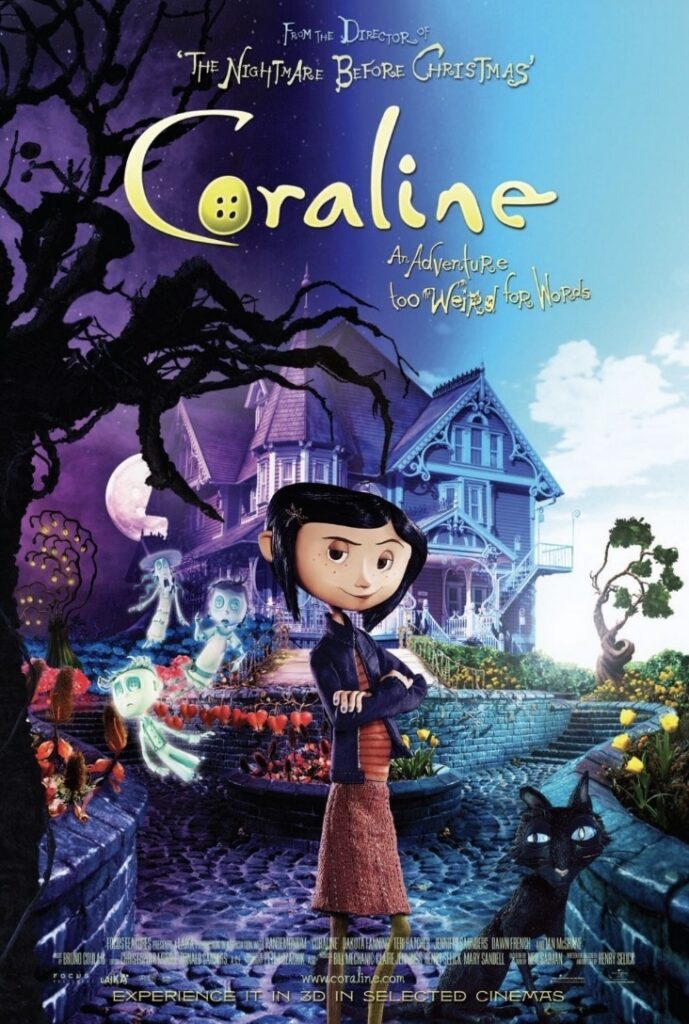
With a $60 million budget, the film had received over $185 million in box office revenue. After seeing the film once, it’s clear why it received so much success. The film utilizes a technique called stop-motion animation, where real-world objects are used to create an animated film. This makes the animation style iconic and creates a unique look that evokes the idea of dolls moving around on their own. This semi-realistic animation style also makes the tones and colors of each scene stand out. The real world is bleak to signify Coraline’s distaste with reality, while the Other World has brighter, more eye-catching colors. As the truth behind the Other World comes to light, it keeps the bright colors but takes on a much more sinister tone.
Many of the characters are memorable for their strange personalities. The characters seen in the real world have some sort of trait that makes them stand out, from Coraline’s new and awkward friend Wybie to her theatrical neighbors Mr. Bobinsky, Ms. Spink, and Ms. Forcible. Even Coraline’s parents are iconic for their over-the-top blandness. In the Other World, these character’s eccentricities are turned up to eleven. However, as the bliss of the Other World unravels, it becomes clear that the Other versions of Coraline’s friends, neighbors, and parents are all a facade created by the Other Mother. They soon transform into horrifying abominations designed to hinder Coraline’s escape. Retroactively, these designs of the Other World characters are intentionally creepy and would be terrifying for any child watching the film.
The soundtrack of “Coraline” also really adds to the overall mood of the film. The soundtrack can be both exciting and haunting, complementing well with the film’s turn into dark fantasy. For the most part, the track was composed by Bruno Coulais, who did an excellent job of making the world of Coraline feel even more unsettling and interesting. The only song Coulais did not compose was the “Other Father’s Song,” which was composed by the band They Might Be Giants. This song is distinct in that it is the only song with lyrics and subtly foreshadows the Other’ Mother’s true intentions.
Overall, “Coraline” should be on your watch list one hundred percent this Fall. It is an excellent horror movie for those who do not enjoy most horror movies and want to watch something that is only slightly creepy. The movie is available on Amazon Video and other streaming platforms. My name is Vincent, and this is the Movie Minute.