
By: Asavari Gowda ‘25 – published in Fall 2024 Issue 2
Images of women in traditional sorochka skirts while carrying guns on their backs and wearing aviators are not the images the American news media typically associates with the Russia-Ukraine War. For Dr. Oksana Kis, these images are the staple of the enigmatic wartime phenomenon known as hybrid feminism. Imagine Wonder Woman but in Ukranian military gear and flowers in her hair.
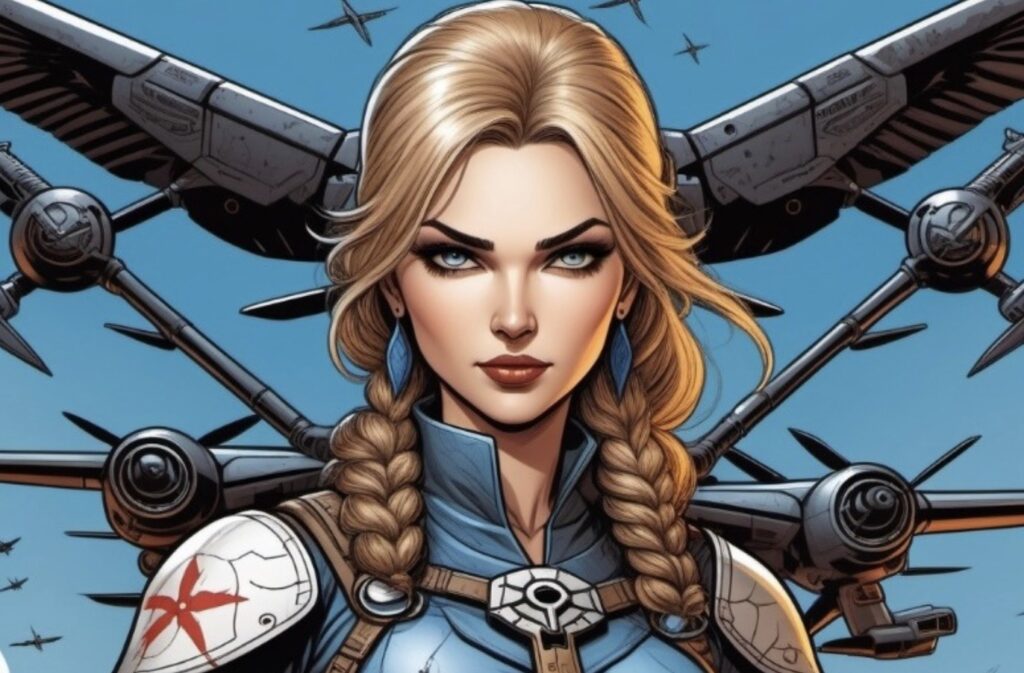
Dr. Kis, a feminist historian and anthropologist, came to Siena last month to talk with students about ‘the woman soldier’ and what hybrid feminism means for Ukrainian women living amid territorial warfare.
Dr. Kis is a senior research fellow and head of the Department of Social Anthropology at the Institute of Ethnology, National Academy of Sciences of Ukraine. She is also the president of the Ukrainian Association for Research in Women’s History. She has done extensive research into the experiences of Ukrainian women during various dire historical periods, including the Holodomor and the time during Stalin’s Gulag. She has several publications and a novel on topics ranging from women in the underground nationalist movement in Western Ukraine in the 1940s and 1950s to modern-day gender politics in the case of Yulia Tymoshenko to the intricate responses of Ukrainian mothers during the national feminine, or Holodomor.
For her talk at Siena, Dr. Kis focused on how the image of the woman soldier, representative of hybrid feminism, has developed over the decades and what it has come to represent for women in Ukraine. Online images of militant feminism first arose in 2014. They painted a story of women being half civilian, half warrior. Thus, being a warrior and being a woman are not mutually exclusive nor does militant feminism oppose traditional feminism. Rather, being a warrior is an extension of Ukrainian femininity. Furthermore, militant feminism is not about violence or warfare at all. Militant feminism is about the self-agency that women should have. It is about women being patriotic and advocating for the rights of themselves, their families, and their communities.
This self-agency is a theme across Dr. Kis’s work. Her paper on the experiences of Ukrainian mothers during Holodomor, the Soviet-created famine in Ukraine, detailed how mothers would resist Soviet dekulakization by protesting, taking up arms to defend their property, and even seeking legal methods to object to unlawful activities in their communities. Dekulakization was a totalitarian campaign by the Soviet Government to eliminate the kulaks, a wealthier peasant class that owned lands, through deportations, arrests, and executions. With men often being the target of these efforts, women were left to fend for their families. These women were mostly illiterate and lived during a time when women were not politically active or within any community leadership roles. They ultimately just wanted to protect their children, who were starving during Holodomor, and in doing so, were fighting for the liberation of the Ukrainian people from Soviet dictatorship.
This idea of women stepping up for their people is seen in more recent times as well. ‘Women’s squads’ were formed to focus on advocacy and patriotism because women felt the traditionally male-led advocacy groups were overlooking them. This was especially necessary due to the Euromaidan protests in 2013 against former President Yanukovich’s decision not to sign a free trade agreement and political association with the European Union. Dr. Kis described how women who joined these protests experienced significant sexism that belittled their rights to protest as Ukranian citizens and patriots. Thousands of women joined the Ukrainian armed forces in 2014 after Russian military aggression. As of December 2021, there were 32,500 female soldiers in the Ukrainian army, and, as Dr. Kis explained, they are all volunteers since military service in Ukraine is “a duty for men and a right for women.” Over the last decade in particular, there has been a significant increase in the number of Ukrainian women police officers and combat officers. In 2021, the “Day of Defenders of Ukraine,” a holiday to remember veterans of Ukrainian armed forces, was renamed by parliament so that both the masculine and feminine Ukrainian words for “defender” were included in the name. Thus, the direct translation would be “The Day of the Men and Women Defenders of Ukraine.”
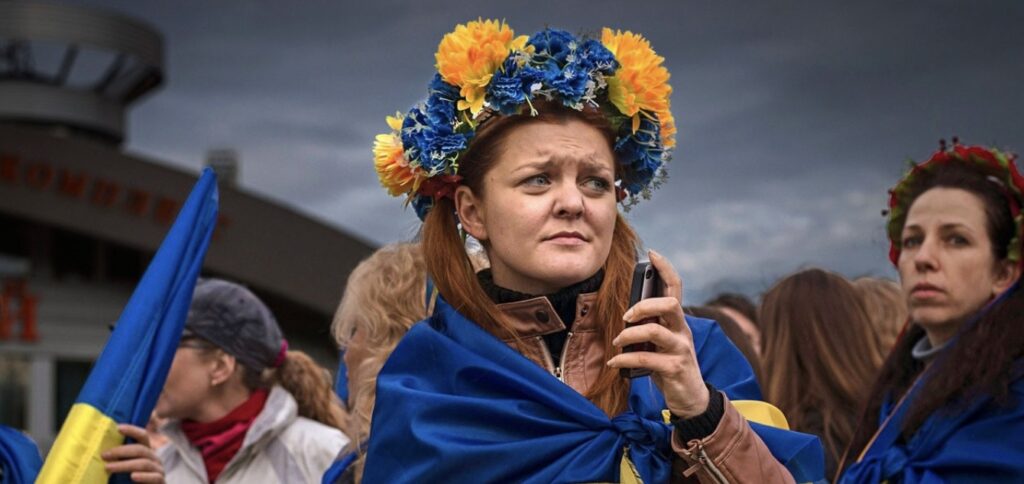
Dr. Kis shared stories of other female war heroes including Lyudmila Pavlichenko, a legendary Soviet sniper in the Red Army who is considered the greatest female sniper in history with 309 enemy kills. Yulia Payevska is another hero who was recently released from Russian captivity. She is a volunteer combat paramedic who has been providing medical support during the ongoing Russia-Ukraine War.
What is so special about the growing impact Ukrainian women have had in the defense of their nation is that their efforts are all voluntary and organized at a grassroots civilian level. They are trying to fight for their country and their right to defend it. In 2023, a new memorial coin of the “woman defender” was presented showing a mother with a small child and a woman in a bulletproof vest holding a machine gun. Ultimately, the synthesis of this hybrid feminist concept, militant feminism, was meant to turn victimhood into self-agency. It was a movement by women for women that was motivated by patriotism and loyalty to both their country and their rights as citizens.